Smoke Detector Placement for Cabins and A-Frames
By Karen Whitfield · Published · 5 min read
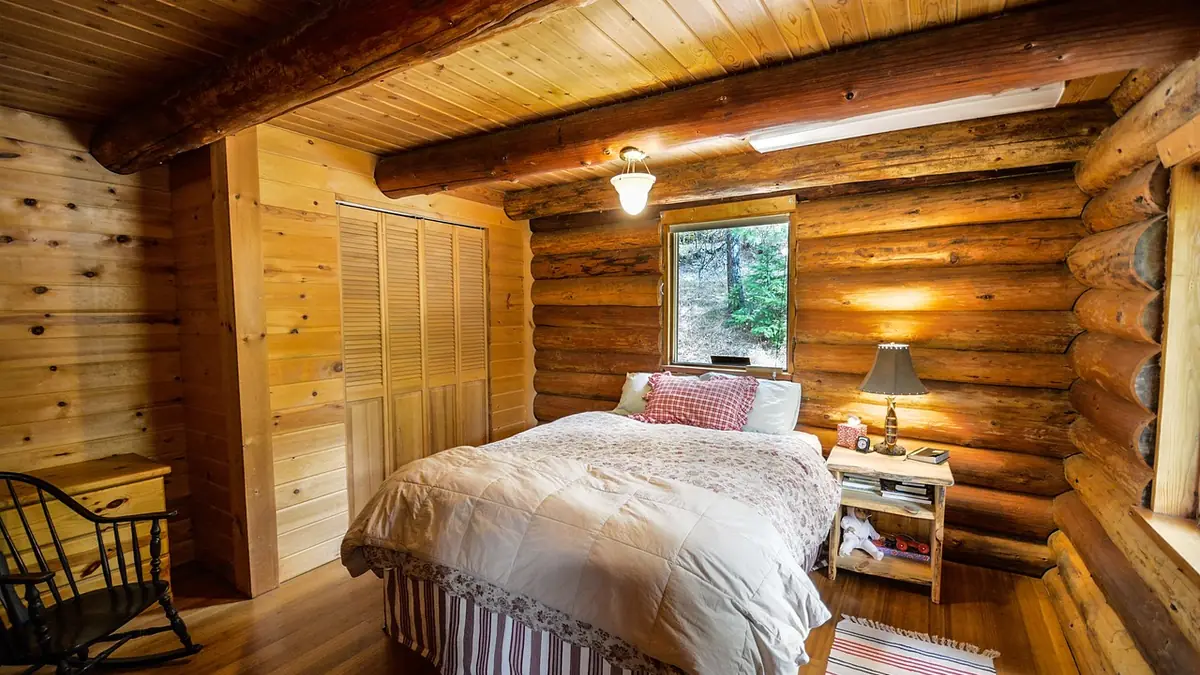
A-frame roofs, open lofts and vaulted great rooms look great and behave badly when it comes to smoke. Hot smoke rises fast along a steep ceiling and can pool in a peak long before it reaches an alarm mounted on a wall or a flat patch of drywall.
The good news is that placement in a cabin is mostly a set of measurements, not guesswork. Get the distances right, put an alarm near every place someone sleeps, and test the system monthly — the rest is upkeep.
Start With the Sleeping Rooms, Not the Ceiling Peak
Every bedroom, and every room that functions as a bedroom, needs its own alarm, whether that is a small bunk room under the stairs or a curtained sleeping nook off the loft. If two or more people sleep past a closed door, add an alarm inside each room plus one in the hallway outside. In a cabin where guests arrive late and doors stay shut, that interior alarm is the one that wakes them.
Mountain cabins also tend to have sleeping spaces that were added later — a converted den, a pull-out in a finished basement room. Treat these as bedrooms. If someone regularly sleeps there, it needs an alarm on the ceiling or high on the wall, and it should be interconnected with the rest of the system so everyone hears the same warning at the same time.
- One alarm inside every sleeping room
- One in the hall outside each sleeping area
- Interconnect all alarms so one sounds them all
- Include converted dens and basements where guests sleep
Sloped and Vaulted Ceilings: The 4-Inch and 12-Inch Rules
On a pitched ceiling, smoke collects in the high air near the ridge. The standard guidance is to keep the alarm within 4 to 12 inches (roughly 10 to 30 cm) of the peak measured horizontally, but no closer than 4 inches to the actual apex. Mounting it right at the very top can leave the sensor in a small pocket of still air, and mounting it a few feet down the slope can delay response by a minute or more.
A-frame homes often have no flat ceiling at all, so this is the rule that matters most. If the ridge is out of reach without a tall ladder, a wall mount 6 to 12 inches below the peak on the gable end is a reasonable alternative. Do not mount low on a sloped wall near a stove or a wood heater, where temperature swings and cooking smoke cause nuisance alarms.
- Keep 4 to 12 inches from the ridge horizontally
- Never mount within 4 inches of the apex
- Wall-mount on the gable end if the peak is unreachable
- Stay high, but away from heaters and cooking zones
Lofts, Open Stairs and Dead Air
An open loft above a great room is one of the hardest layouts. Smoke from a ground-floor kitchen fire rises through the open volume and may not reach a loft alarm until the plume is well developed. Put an alarm on the loft ceiling or high wall, and make sure the ground floor has coverage too, so a fire below is caught early rather than only after it climbs.
Dead air spaces are the other trap. Keep alarms at least 3 feet (about 1 meter) away from where a wall meets the ceiling, and the same distance from ceiling fans, light fixtures and HVAC registers. In a vaulted room, the corner where the sloped ceiling meets a side wall is dead air — smoke swirls past it without entering the sensor chamber. Also stay 3 feet from the door of a bathroom with a shower; steam sets off alarms reliably.
- At least 3 feet from wall-to-ceiling corners
- 3 feet from fans, fixtures and air vents
- 3 feet from bathroom doors with showers
- Cover the ground floor as well as the loft
Which Sensor Type Suits a Cabin
Ionization alarms respond quickly to fast, flaming fires such as a grease pan or a paper fire. Photoelectric alarms are better at slow, smoldering fires, which is what a wood stove with a partly closed damper or an overloaded extension cord tends to produce. In a cabin full of wood furniture and stove fuel, the smoldering scenario is common, so photoelectric or dual-sensor units are a sensible default.
Many mountain homes now use combination alarms with both sensors plus carbon monoxide detection. That matters where a wood stove, a propane heater or an attached garage is present. Expect to pay somewhere in the range of $20 to $50 per unit for a good dual-sensor alarm, and consider a sealed 10-year battery model for cabins that sit empty for weeks — it removes the temptation to borrow the battery for something else.
- Photoelectric or dual-sensor for smoldering wood-stove fires
- Add CO detection if you burn wood or propane
- Sealed 10-year battery models suit part-time cabins
- Typical cost: about $20 to $50 per alarm
| Location | Mounting position | Minimum clearance | Notes |
|---|---|---|---|
| Sloped ceiling near ridge | Ceiling, 4–12 in. from peak horizontally | 4 in. from apex | Best spot in an A-frame if reachable |
| Vaulted wall (gable end) | Wall, 6–12 in. below peak | 3 ft from side-wall corner | Fallback when ridge is too high |
| Loft above great room | Ceiling or high wall of loft | 3 ft from fans and vents | Add ground-floor alarm as well |
| Bedroom or bunk room | Ceiling or wall | 3 ft from corner | One alarm per sleeping room |
| Hall outside sleeping area | Ceiling | 3 ft from bathroom door | Interconnect with bedroom alarms |
| Kitchen | Ceiling or wall | 10 ft from stove | Use hush button, never remove battery |
| Unheated attic or garage | Not recommended | — | Outside rated temperature range |
Testing, Batteries and Replacement in a Part-Time Home
A cabin that is empty for long stretches is where alarms quietly fail. Test every unit monthly while you are there, and press the test button on each one, not just the nearest. Replace batteries at least once a year, or sooner if a low-battery chirp starts; pick a fixed date such as the first snow or the start of the season so it is never forgotten. Our guide to how often to replace smoke detector batteries walks through the timing.
The alarm itself has a lifespan. Most manufacturers rate units for 10 years from the date of manufacture, printed on the back label, and sensors drift out of calibration after that. Write the install date inside the cover with a marker. If you are resetting a whole cabin, work out how many smoke detectors a typical Mammoth Lakes home needs before you buy, so you cover the loft, bedrooms and hall in one order.
- Test monthly while the cabin is occupied
- Change batteries at least yearly, on a fixed date
- Replace the whole unit every 10 years
- Mark the install date inside the cover
Where Not to Put an Alarm
The kitchen is the most common mistake. An alarm within a few feet of a stove or toaster will sound on ordinary cooking, and repeated false alarms lead people to disable it. Keep alarms at least 10 feet (about 3 meters) from a cooking appliance, or use a unit with a hush button if the layout leaves no choice. The same distance logic applies to a wood stove or fireplace — heat and smoke near the flue can trip a sensor that would otherwise be fine.
Skip unheated attics and crawl spaces, garages, and rooms that stay below about 40°F (4°C) or above roughly 100°F (38°C), since most residential alarms are rated only for that range. A closed-up cabin that bakes in summer sun or freezes in January is exactly the environment where an out-of-range alarm fails silently. Before winter, pair the placement check with our chimney and wood stove safety checklist.
- At least 10 feet from stoves and cooking appliances
- Not in garages, attics or crawl spaces
- Only where temperatures stay roughly 40–100°F
- Use hush buttons instead of removing batteries
- Put an alarm inside every sleeping room and in the hall outside, interconnected.
- On a pitched roof, mount 4–12 inches from the ridge horizontally, never within 4 inches of the peak.
- Keep alarms 3 feet from corners, fans and bathroom doors, and 10 feet from stoves.
- Test monthly, change batteries yearly, and replace the whole unit every 10 years.
Karen has spent years writing and editing public safety guidance for mountain communities, with a focus on home fire prevention and clear emergency instructions. She works closely with local fire service information and community records to keep practical advice accurate and easy to follow. Her goal is to help residents prepare before an emergency happens.